The best low budget marketing strategies start by finding a starving crowd: people who already want what you sell. Then launch cheaply to people you already know, borrow audiences through partners, write specific, story-led copy, use honest scarcity, and convert visitors with simple landing pages. Measure everything, keep what works, and turn one-off buyers into subscribers so each customer pays you more than once.
Key takeaways
- Find the hunger first. A starving crowd beats a better product, a better location and a lower price.
- The cheapest customers are the ones closest to you: past customers, contacts, partners and their audiences.
- Honest scarcity, specific copy and simple pages turn attention into sales. Fake urgency now attracts regulators.
- StumbleUpon, SlideShare tricks and organic Facebook reach have faded. Short video, communities, newsletters, creators and AI search have replaced them.
- For a subscription, every low-cost tactic is worth more, because a customer you win keeps paying.
People used to ask me how long it took to write Feed a Starving Crowd.
My answer was fifteen years.
That book was the result of fifteen years of testing, trying, failing, succeeding and everything in between. I'd used online marketing to sell investment properties worth hundreds of thousands of dollars and baby toys worth a few dollars each. Photocopiers, enterprise software, training courses, books. I once sold 800 dog baths in 24 hours with email marketing. (That was so much fun.)
Once I got 8,000 people registered for a client's webinar, and it crashed the server.
And through all of it, one lesson kept coming back.
It doesn't matter what industry you're in. Marketing is about finding a starving crowd, then feeding it what it wants.
This hub is the whole Feed a Starving Crowd system, chapter by chapter, updated for 2026. Each section links to a full guide. Some platforms from the original book are gone. The principles are as strong as ever. And because I've spent the years since building subscription businesses, I've connected each idea to recurring revenue wherever it fits.
What are the best low-budget marketing strategies?
If you only remember one paragraph from this page, make it this one.
- Find the hunger first. Sell to people who already want what you sell. That's a starving crowd.
- Start with people who know you. Past customers, contacts and partners are far cheaper than strangers.
- Borrow audiences. Partners, newsletters, podcasts and communities already have your customers' attention.
- Say something specific. Story-led, specific copy that makes people buy beats a bigger ad budget.
- Give people an honest reason to act now. Real limits, real deadlines. Scarcity without being slimy.
- Make it easy to say yes. Simple pages, few choices, a clean checkout.
- Test everything. Keep what rings the bell. Drop what doesn't.
- Make each customer worth more. Turn one-off buyers into subscribers.
For 101 specific ideas you can start today, see small business marketing with no budget.
What is Feed a Starving Crowd?
Feed a Starving Crowd is my first book, published in 2013/14, with the subtitle "More than 200 hot and fresh marketing strategies to find hungry customers." (The Subscription Playbook calls it 227 strategies. I stopped counting at some point.)
The title comes from a story my mentor Gary Halbert told his students. If you owned a hamburger stand and wanted to sell more hamburgers than anyone else, what advantage would you want? Better meat? A better location? Lower prices? Halbert said he'd give you all of those if he could have just one: a starving crowd.
I wrote the book like a workbook, with action exercises in every chapter, because nothing would disappoint me more than someone reading it and doing nothing. Halbert once made marketer Joe Polish withdraw $21,000 in cash and then threw it around the office, shouting that every day Joe didn't act on good advice was another $1,000 down the drain.
The same applies here. Read a guide, then do the exercise at the end.
The Feed a Starving Crowd chapters, updated for 2026
Here's every chapter, what still works, what's changed, and where to read the full guide.
| Chapter | The big idea | Still works | Updated for 2026 | Full guide |
|---|---|---|---|---|
| 1. Feeding a starving crowd | Find hungry buyers before you market | Keyword research, three-star reviews, asking customers | AI assistants, Reddit, video comments and software reviews as research sources | The starving crowd principle and how to find a niche market |
| 2. Launch fast and cheap | No budget, no list, no product? Launch anyway | Webinar launches, borrowing a partner's list | Live streams, newsletter swaps, founding-member pre-sales | Launch fast and cheap |
| 3. Scarcity without being slimy | Loss aversion drives action | Real limits, early bird windows, rising prices | Regulators target fake timers; Australia's unfair trading ban starts 1 July 2027 | Scarcity marketing |
| 4. Copy that makes people buy | Halbert's lessons, "how to" headlines, the sales page anatomy | Everything | AI drafts, human market knowledge | Copywriting that sells |
| 5. Web designs that convert | Simple pages, split tests, the forgotten checkout | Message match, fewer fields, testing | Mobile-first, current benchmarks, subscription disclosure | Landing pages that convert and subscription landing pages |
| 6. Affiliates, bloggers and JVs | Other people's audiences, leaderboards and prizes | JV pitches, affiliate contests | Creators, newsletters, podcasts and integration partners | Joint venture marketing |
| 7. Social media nobody else is doing | Go where the crowd is, before everyone else | Being early, being human | StumbleUpon and SlideShare tactics replaced by short video, LinkedIn, Reddit and communities | Social media for small business |
| 8. Low-budget video and ad campaigns | Cheap, targeted traffic | Small tests, tight targeting | Meta and YouTube ads with AI-driven targeting and creative testing | Facebook ads on a small budget |
| 9. Video sales letters | Jon Benson's VSL formula | The structure and the first 90 seconds | Shorter VSLs, captions, vertical video | Video sales letters and the VSL script template |
| 10. Crowdfunding | Pre-sell and build a community at once | Rewards, video, early momentum | Platform changes and Australian tax questions | Crowdfunding |
| 11. The bestseller book | Using a book to build authority | Launch teams, table of contents as sales page | Amazon category strategy, audiobooks | Becoming an Amazon bestseller and book launch strategy |
| 12. Unusual product launches | Launch like Tim Ferriss | Partnerships, giving content away | Waitlists, creator launches, Product Hunt | Product launch strategy |
| 13. Working as a consultant | Getting paid for what you know | Prove results first | Retainers, success fees and productized services | Pricing your consulting work |
The five principles that haven't changed in a decade
Tactics come and go. These five have survived every algorithm change I've seen.
Principle 1: The crowd matters more than the product
When I tested the starving crowd method on my dad's excess stock business, I wrote down 127 phrases his customers might search, picked the best twenty, and did some basic search optimization. It brought in more than 1,000 leads without a cent of advertising.
The website wasn't special. The crowd was hungry, and we sent out the invitations.
In 2026: the same research now includes asking AI assistants your customers' questions. OpenAI said ChatGPT had 800 million weekly users in October 2025, so that's where many of your customers start. See the starving crowd principle.
Principle 2: Try lots of cheap things, fast
When I joined E-Web Marketing, I had ten days to fill a 200-seat room in Melbourne. Two people had registered. We emailed our list, got forty staff posting at once, borrowed an affiliate's database and asked a blogger for a write-up. Half of it failed. The rest filled the room.
The website was ugly and the tracking was broken. The room was full.
In 2026: the cheap things are different (live streams, newsletter swaps, communities, creators), but the method is identical. Read launch fast and cheap.
Principle 3: Scarcity works, so never fake it
People are more motivated to avoid a loss than to gain something. That's why concerts sell out and why "doors close Friday" works.
But fake scarcity has gone from sleazy to risky. The US FTC has called out fake countdown timers as a dark pattern, and from 1 July 2027 Australia's Unfair Trading Practices Act 2026 bans unfair trading practices, with examples including digital design that puts people under unreasonable pressure. Use real limits instead: capacity, founding places, a published price rise. My scarcity guide lists ten honest tactics.
Principle 4: Copy beats design (but design earns trust)
One of my mentors has a horrible website. I hired him anyway because the words were brilliant. My wife, on the other hand, would never buy from a site that looked unprofessional.
You need both. Specific, story-led copy, and a clean, trustworthy page. In one split test, simply removing the words "claim your" from a button doubled conversions. Start with copywriting that sells, then landing pages that convert.
Principle 5: Other people already have your customers
Somebody already has the attention of the exact people you want to reach: a partner business, a newsletter, a podcast, an association, a creator. Joint ventures helped one investment company sell $500 million of products in a year, a story I tell in the joint venture guide. You don't need anything that big. A local dance studio I worked with built a referral network with swim schools, preschools and dancewear shops for nothing.
Starving Crowd Niche FinderScore niche ideas the Feed a Starving Crowd way.Open the free tool →What's changed since the book came out?
I'd be doing you a disservice if I pretended the original tactics all still work. Here's my honest list.
What's gone or faded
- StumbleUpon became Mix in 2018, and the traffic trick went with it.
- SlideShare's front page was a traffic hack in the book. It's no longer the shortcut it was.
- Organic Facebook page reach for businesses fell away years ago. Groups still work; pages mostly don't.
- Google+ closed for consumers in 2019.
- Ugly squeeze pages still convert, but many ad platforms and buyers now expect more substance.
What's replaced them
- Short vertical video on TikTok, Instagram Reels and YouTube Shorts, often filmed by the founder on a phone.
- LinkedIn for B2B, especially personal posts from the owner.
- Communities on Reddit, Discord, Slack, WhatsApp and Facebook groups.
- Newsletters you can sponsor, swap with or guest on.
- Creators and podcasts as the new "bloggers" from Chapter 6.
- AI search. People ask assistants for recommendations. Being the clear, specific, quoted answer is the new SEO.
- Product Hunt and niche launch communities for software.
What's become more important
- Owning your audience. Click Frenzy, the Australian online sale I wrote about, went into liquidation in April 2026. Within weeks, SmartCompany reported, Catch's co-founders bought it, including a subscriber base of more than 1.5 million email addresses and phone numbers, and relaunched it in June. Platforms change; a list of people who said "yes, contact me" keeps its value.
- Honesty. Regulators, platforms and buyers have all become far less tolerant of fake urgency, fake reviews and hidden terms.
- Testing. It's never been cheaper to run a small test. Unbounce's benchmark puts the median landing page conversion rate at 6.6%, so you have a yardstick for your first results.
Ask both books a question
Stuck on a marketing problem? Ask the Book searches Feed a Starving Crowd and The Subscription Playbook and gives you an answer in seconds.
How does this apply to subscription businesses?
When I wrote Feed a Starving Crowd, I was running marketing campaigns where almost every sale was one-off. Great launches, then silence. Feast or famine. It's why I eventually sold my first business, and the reason I wrote The Subscription Playbook.
Put the two books together and something powerful happens. Every low-cost tactic in Feed a Starving Crowd is worth more when the customer you win pays you every month.
- The starving crowd becomes a recurring hunger. Pick problems that come back every week or month, and match them to the right subscription model.
- Launches become founding-member offers. Pre-sell an annual membership to fund the build. See launch fast and cheap.
- Landing pages answer three extra questions. What do I get each month, what will it cost over time, and how do I get out? See subscription landing pages.
- Referrals and communities compound. The four techniques in my guide to growing a subscription business on a shoestring (community, webinars, referrals and integrations) are the Subscription Playbook's version of this hub.
- You can afford to spend more to win a customer, because you know what they're worth. Check your numbers with the LTV:CAC and payback calculator and read the LTV:CAC ratio guide.
Worked example: why a subscriber changes the marketing math (illustrative)
A dog groomer charges $90 a visit. A one-off customer brings about $45 of gross profit, so a $40 cost to win them barely pays. Now offer a membership at $80 a month for a monthly groom. If members stay 14 months on average at a 50% margin, each is worth about $560 of gross profit. The same $40 to win a customer is now a bargain, and even a $150 partnership or ad campaign that wins two members pays back several times over. Same marketing, different model, completely different math.
A 30-day low-budget marketing plan
Here's how I'd use the guides on this site if I were starting from zero tomorrow.
Week 1: Find the crowd. - Write twenty search phrases and ask AI assistants your customers' questions. - Read thirty three-star reviews or complaints in your niche. - Score two or three niches with the Starving Crowd Niche Finder.
Week 2: Build the offer and the page. - Write 25 headlines. Pick the most specific and surprising. - Build one simple landing page or waitlist. - Decide on one honest reason to act now, such as a founding price for the first fifty.
Week 3: Launch to people who know you. - Message your contacts, past customers and LinkedIn connections personally. - Ask one partner to co-host a free live session or mention you to their audience. - Run the session: 55 minutes of teaching, five minutes of offer.
Week 4: Measure and double down. - Count sign-ups, sales and show rates. Which channel rang the bell? - Ask every buyer how they heard about you and what nearly stopped them. - Put a small budget behind the best-performing message. See Facebook ads on a small budget.
How do you choose which strategy to use first?
| Your situation | Start with | Then |
|---|---|---|
| Brand new idea, no customers | Find a niche and test demand | A bare-bones launch to your network |
| Existing customers, flat growth | Referrals and past-customer emails | A partner or joint venture |
| Good traffic, poor sales | Copywriting and landing pages | Checkout fixes |
| A product people love but nobody knows | PR, social media and creators | A product launch |
| Expertise, no product | Consulting or a book | A membership or productized service |
| Something physical needing upfront cash | Crowdfunding | A subscription for repeat buyers |
| A high-ticket offer | A video sales letter or webinar | Affiliates with a leaderboard |
When is low-budget marketing the wrong choice?
Low-budget marketing is perfect for testing, for small businesses and for anyone who'd rather spend time than money. It isn't always the right call.
- When your time is worth more than the result. If you're spending ten hours a week on DIY social posts that bring one customer a month, paying for help or a proven channel is cheaper.
- When the window is short. A seasonal business or a time-limited opportunity may need paid reach to move fast.
- When you've proven what works. Once a channel reliably pays back, starving it of budget is a false economy. Scale it.
- When the product isn't ready. Cheap marketing amplifies whatever experience you deliver. If customers are disappointed, more customers just means more disappointment.
What to do next
- Read the starving crowd principle and do the action exercise.
- Pick five ideas from the 101 low-budget marketing ideas and start them this week.
- Plan a small launch using launch fast and cheap.
- Tighten your words and your page with the copywriting and landing page guides.
- Download the books. Both ebooks and the Subscription Playbook audiobook are free in the book bundle.
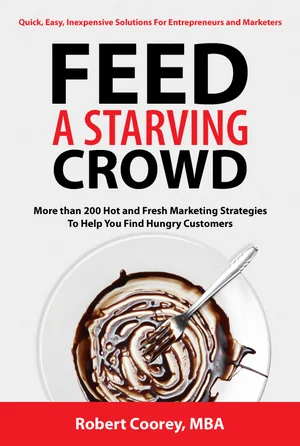
Get Feed a Starving Crowd free
Robert's first book: more than 200 low-cost marketing strategies to find hungry customers. Free PDF and ePub.
Download it freeMore in this section
How to Become an Amazon Bestseller
How to become an Amazon bestseller: how rankings work, choosing categories, building a launch team, getting honest reviews and packing sales into one day.
Book Launch Strategy
A practical book launch strategy: a 12-week plan, pre-orders, launch teams, podcasts, bonuses and partners, and how to turn a book into a lead engine.
How Much to Charge for Consulting
How much to charge for consulting: a day-rate formula with a worked A$ example, five pricing models from hourly to equity, and when to use a retainer.
Copywriting That Sells
Copywriting that sells in 2026: Gary Halbert's two lessons, the headline that always works, a 10-step sales page formula, and AI without the AI sound.
How to Run a Successful Crowdfunding…
How to run a successful crowdfunding campaign: the five elements backers pay for, reward math, the record Kickstarter that was a subscription, and AU tax.
Facebook Ads on a Small Budget
How to run Facebook and Instagram ads on a small budget: work out what a customer is worth, set a budget Meta's learning phase can use, and test cheap video.
How to Find a Niche Market People Are…
How to find a niche market with real demand: the Amazon three-star review method, 2026 research sources, a niche scorecard, and a $60 test to pick your name.
Joint Venture Marketing
Joint venture marketing with real examples: how Jay Abraham found $500m, where to find partners in 2026, what to pay them, and how to get them to mail.
Landing Pages That Convert
Landing pages that convert: the page that got 7,991 webinar sign-ups for under $2,000, split tests that doubled results, 2026 benchmarks and a checkout fix.
How to Launch a Product With No Budget
How to launch a product with no budget, no list and no product yet: the bare-bones webinar launch, a $100,000 social launch, and what Click Frenzy taught us.
Low-Budget Marketing
101 marketing strategies for small business with no budget, from Feed a Starving Crowd and updated for 2026: lists you own, AI search, partners and more.
Product Launch Strategy
A product launch strategy built from real launches: Mindvalley's $1m sequence, a tour sold out with no paid ads, a pre-sold $1m course and a viral email.
Scarcity Marketing
Scarcity marketing that works and stays legal: why people rush to buy, what Taylor Swift and Catch teach, fake urgency rules in 2026, and 10 honest tactics.
Social Media Marketing for Small Business
Social media marketing for small business, updated for 2026: what still works from Feed a Starving Crowd, what died, and the tactics few competitors use yet.
The Starving Crowd
Gary Halbert's starving crowd principle explained by the author of Feed a Starving Crowd: spot hungry buyers, score your market, and build recurring sales.
How to Make a Video Sales Letter That…
What a video sales letter is, Jon Benson's 5-step VSL formula with real examples, how long a VSL should be, and how to make one cheaply and honestly in 2026.
Frequently asked questions
Is Feed a Starving Crowd still relevant in 2026?
The principles are. Finding hungry buyers, launching cheaply, honest scarcity, story-led copy, testing everything and borrowing other people's audiences all work as well as they did in 2013. Some tactics have aged badly, especially those built on StumbleUpon, early Pinterest and organic Facebook reach. The guides on this site keep the principles and stories and replace the dead tactics with 2026 equivalents.
How many strategies are in Feed a Starving Crowd?
The cover promises more than 200 hot and fresh marketing strategies to find hungry customers, and The Subscription Playbook refers to it as having 227. They're spread across thirteen chapters covering niches, launches, scarcity, copywriting, web design, affiliates and joint ventures, social media, low-budget ads, video sales letters, crowdfunding, bestselling books, product launches and consulting.
Can I download Feed a Starving Crowd for free?
Yes. The ebook is free to download for everyone, worldwide, along with The Subscription Playbook ebook and audiobook. Registered Australian business owners can also claim a free hardcover of The Subscription Playbook, one per business, while stock lasts. Details are on the free book and bundle pages.
What's the difference between low-budget marketing and growth hacking?
Mostly the label. Growth hacking became popular in startups for fast, experimental, low-cost growth tactics, often built into the product, such as referral rewards and shareable outputs. Low-budget marketing covers the same ground plus the old-fashioned stuff: partnerships, PR, events, letters and great service. Both depend on testing cheaply and doubling down on what works.
Which marketing strategy should a brand new business start with?
Validate the crowd, then sell to your own network. Confirm there's real demand with search data and real complaints, then offer a founding deal to people who already know you, plus one partner who serves the same customers. That first group pays you, gives you testimonials and tells you what to fix. Only then is it worth paying for ads.

Get both books free
The Subscription Playbook (ebook + audiobook) and Feed a Starving Crowd, instantly. In Australia? Claim the free hardcover.

Robert Coorey, MBA
Robert is the author of The Subscription Playbook and Feed a Starving Crowd and a Director at BPAG Accountants in Sydney. More about Robert.
Sources
- Robert Coorey, Feed a Starving Crowd (2013/14)
- Robert Coorey, The Subscription Playbook (Aviva Publishing, 2022)
- FTC, FTC Report Shows Rise in Sophisticated Dark Patterns (Sep 2022)
- Competition and Consumer Amendment (Unfair Trading Practices) Act 2026, Federal Register of Legislation
- TechCrunch, Sam Altman says ChatGPT has hit 800M weekly active users (6 Oct 2025)
- SmartCompany, Click Frenzy returns in June 2026 with free registration for 500 retailers
- Unbounce, Conversion Benchmark Report
Facts and prices checked 27 October 2026. Spotted something out of date? Tell us.