Scarcity marketing uses genuinely limited quantity, time or access to encourage people to act now instead of later. It works because people feel a loss more strongly than an equal gain. Used honestly, with real limits like capacity, founding places or a fixed price-rise date, it's fair and effective. Fake timers and false stock claims mislead buyers and can breach consumer law.
Key takeaways
- Scarcity works because of loss aversion: missing out hurts more than gaining feels good.
- Real scarcity (capacity, cohorts, founding places, genuine deadlines) is fair. Fake scarcity is misleading, and regulators in Australia, the US and the UK have called it out.
- From 1 July 2027, Australia's new unfair trading practices ban covers digital design that puts people under unreasonable pressure.
- Urgency can win a sale but it isn't a moat. Catch used scarcity brilliantly and still closed in 2025.
- For subscriptions, the best scarcity is a limited founding group or a real enrollment window.
Your favorite performer is coming to town. Tickets go on sale at 10 a.m. tomorrow.
You're at your computer from 9 a.m. You're pressing refresh like your life depends on it. At 10:01 the site slows to a crawl. At 10:03 you see the words: sold out.
How do 100,000 tickets sell in three minutes?
And why, when you run your own little event, do you push for weeks and still struggle to sell a ticket?
To answer that, we need a bit of psychology, a bit of history, and a look at the tactics promoters actually use. Then you can use the honest versions in your own business.
Why does scarcity marketing work?
If you want something and you think it's running out, you'll do almost anything to get it right now.
Psychologist Daniel Kahneman called the underlying idea loss aversion. People are far more motivated to avoid a loss than to gain something of equal value. Missing out on a ticket you wanted hurts more than finding $100 on the street feels good.
That's the engine behind every "limited time," "only 20 left" and "doors close Friday."
And it's very powerful. Which is exactly why you have to use it carefully.
A short history of scarcity
- Tulips, 1600s. When tulips came to Holland, a virus gave some bulbs rare streaked patterns. Rarer bulbs became more desirable, prices went up twentyfold, and people traded whole estates for single bulbs. Then the selling started, and by the end a bulb was worth about as much as an onion. Scarcity can move an entire economy, in both directions.
- Beef buyers, 1982. Amram Knishinsky studied wholesale beef buyers. When told a shortage of imported beef was likely, they more than doubled their orders. When also told that nobody else had that information yet, orders rose 600%.
- The Disney Vault, from 1937. Disney rereleased Snow White and then put it back "in the vault" for an unknown time. Films on moratorium became collectibles. Same product, more desire.
How do concerts sell out in minutes?
Dean Budnick and Josh Baron got so sick of missing out on tickets that they interviewed around 100 people in the events industry and wrote a book about it, Ticket Masters.
The main secret? Only a small share of seats goes on general sale.
Before the public on-sale, tickets are allocated to credit card partners, fan clubs, promoters, sponsors and the venue. For Justin Bieber's Nashville show in January 2013, only 7% of tickets were available at the general sale. For Taylor Swift's US concerts at the time, about 15%.
So the "sold out in three minutes" headline is real, but the three minutes were never the whole sale.
The 2026 update: the queue became the marketing
For The Eras Tour in November 2022, Ticketmaster said more than 3.5 million people pre-registered for its Verified Fan presale, which it called the largest registration in its history. About 1.5 million were sent codes. The other 2 million went on a waitlist. More than 2 million tickets sold on 15 November, which Ticketmaster said was the most ever sold for one artist in a single day.
The system buckled under 3.5 billion requests, and the general public sale was later called off. That caused enormous frustration.
But look at the structure. Registration created a list. Codes created exclusivity. The waitlist created a second wave of desire. Whatever you think of the experience, it's the ticket-allocation playbook from the book, scaled up with software.
Your version: open a waitlist before launch, give the waitlist first access, and give your best customers access before that. You'll fill faster, and you'll know your demand before you open the doors.
What can you learn from Apple's launches?
When I wrote the book, Apple sold 2 million iPhone 5s in the first 24 hours of preorders, even though the phone wasn't dramatically different from the last one.
Apple's trick was to keep its secrets. It announced a press event without saying what it was about, and let the media speculate for free. When preorders opened, it said demand was so heavy that stock was limited, and the phone stayed on back order for weeks.
We adapted this at E-Web for book launches. We'd email a list just the book cover. No description, no price, no order link. With an engaged list, the response was massive. One day our poor admin manager spent the whole day telling people to be patient.
Curiosity is a cousin of scarcity. "You can't have it yet" works almost as well as "you can't have it for long."
Is scarcity marketing ethical?
My friends Marilyne and Wyatt Woodsmall, behavioral modelers who coached the US Olympic diving team, put it well when I was writing the book. They pointed to Robert Cialdini's distinction between "influence sleuths" and "influence thieves." Both know how scarcity works. Only one uses it to help the customer.
Here's the test I use:
| Honest scarcity | Fake scarcity |
|---|---|
| "We take twelve people per class." (It's true.) | "Only 3 spots left!" (There are 300.) |
| "Founding price for the first 50 members." (And you stop at 50.) | A "limited offer" that never ends |
| A timer counting down to a real deadline | A timer that restarts every time you refresh |
| "Prices rise on 1 March." (They do.) | "Prices rise tomorrow!" (Every day.) |
| "Doors close Friday," and they close | Doors close Friday, then reopen Monday "due to demand" |
People can smell fake scarcity. Even if it works once, it teaches your audience that your deadlines mean nothing. Then your next real deadline doesn't work either.
Stay strong
If you offer a 60-minute fast-action bonus and someone orders after 62 minutes, do they get the bonus? No. It sounds harsh. But if you fudge it, your audience learns they can fudge it too, and your next offer won't be as believable. Honest scarcity only works if you're consistent.
When does fake scarcity become illegal?
This is the big change since the book came out. Regulators now treat fake urgency as a problem, not a clever trick.
- United States. The FTC's 2022 report on dark patterns called out countdown timers designed to make people believe an offer is time-limited when it isn't, along with false low-stock and high-demand messages.
- United Kingdom. The Competition and Markets Authority (CMA) got commitments from some of the biggest hotel booking sites in 2019 and told them to be honest and tell the whole story when using messages like "only 2 rooms left." Later that year, consumer group Which? said five out of ten "only 1 room left" claims it checked on Booking.com didn't give an accurate picture, as the BBC reported.
- Australia. The Australian Consumer Law already bans misleading or deceptive conduct and false or misleading representations, which covers false stock and deadline claims. From 1 July 2027, the Unfair Trading Practices Act 2026 adds a general ban on unfair trading practices. Its examples include using digital design elements that put people under unreasonable pressure. The ACCC has listed fake urgency among the patterns it expects businesses to remove. My guide to what the ACCC expects from subscription businesses covers this in more depth.
This is general information as at October 2026, not legal advice. If your marketing relies heavily on timers, stock counters or "last chance" offers, get it reviewed before 1 July 2027. The compliance checker is a good first pass for subscription sign-up flows.
Is your sign-up flow honest enough for 2027?
Check your timers, trials and cancellation flow against the new Australian rules with the free compliance checker.
What happened to CatchOfTheDay, the scarcity champion?
In the book, I reverse-engineered CatchOfTheDay, then Australia's top shopping site. It sold an item roughly every second, with more than 2 million members.
Its scarcity toolkit was textbook:
- "HURRY, ALMOST GONE!" banners and countdown timers
- Product pages showing some options almost gone and others sold out
- "Stock is not reserved until you complete checkout" in the cart
- A limit of five per customer
- Social posts like "We've sold almost 2,000 pairs of Ugg boots in 2 hours"
That limit of five connects to research by Brian Wansink, who found that signs like "Limit 12 per person" led shoppers to buy 30% to 100% more. (It worked on me too. My supermarket put a limit of four on baby formula, so I bought four.) A word of caution: Cornell found in 2018 that Wansink had committed academic misconduct and he resigned, so treat his numbers as a direction, not gospel.
Here's the update. Wesfarmers bought Catch in 2019 for $230 million. In January 2025 it announced it would wind Catch down as a standalone business, after an expected operating loss of $38 million to $40 million for the six months to December 2024, citing intense competition from bigger international players.
Scarcity tactics win today's sale. They don't protect you from a competitor with more scale and better prices. That takes a moat, which is what I wrote The Subscription Playbook's moats chapter about.
10 honest scarcity tactics for subscription businesses
- A capped founding group. "The first 50 members get the founding price for life." Then stop at 50.
- Cohort intakes. Open enrollment four times a year with a start date. Mindvalley launched one program at the start of each year, when people want change.
- Real capacity limits. Classes, coaching calls and adviser hours are genuinely limited. Say so.
- A published price rise. Announce the date, then honor it. The price increase simulator shows the revenue impact, and my guide to raising prices covers the messaging.
- An early bird annual window. Eben Pagan offered 50% off for the first days only, then the price went back up. An early bird window gives a discount without devaluing the offer.
- A fast-action bonus for live attendees. Something extra for joining during the session, with a clear end time.
- Limited editions in a subscription box. A seasonal item only this month's subscribers get.
- A waitlist with first access. Waitlist members get in before the public.
- Access to you. Founding members get a monthly live Q&A that later members don't.
- Keep raising your prices. At E-Web we raised our setup fees most years between 2004 and 2011. Our entry package went from $495 to $4,990, and the business was named in the Deloitte Fast 50 for the Asia Pacific region five years running. Rising prices are honest scarcity: the deal really does get worse if you wait.
Does more scarcity mean more sales?
The developers of a WordPress plugin called Scarcity Samurai told me they added scarcity at four points in one campaign (a landing page timer, "ends tomorrow" in an email subject line, the exact time left in the email body, and a timer on the sales page) and lifted overall conversion by 453%. That's their claim from their own test, and the deadline was real.
The bigger lesson is consistency. Mention the real limit everywhere: the ad, the page, every email and the checkout.
What to do next
- List every limit that's genuinely true in your business: capacity, dates, places, prices.
- Pick one and build your next offer around it.
- Audit your current marketing for anything fake: resetting timers, invented stock levels, deadlines you've extended.
- Remove anything you couldn't prove to a customer, or to the ACCC.
- Write the limit into your copy. My guide to copy that makes people buy shows where it goes on a sales page.
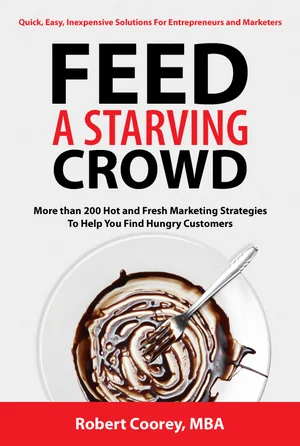
Get Feed a Starving Crowd free
Robert's first book: more than 200 low-cost marketing strategies to find hungry customers. Free PDF and ePub.
Download it freeFrequently asked questions
Is scarcity marketing manipulative?
It can be. Scarcity is manipulative when the limit is invented, like a countdown timer that resets or a stock warning that isn't true. It's fair when the limit is real and you explain it: a class with twelve spots, a founding price for the first fifty members, or a price rise that really happens on a stated date. The test is simple. Would you be comfortable showing the customer the evidence behind the claim?
What's the difference between scarcity and urgency?
Scarcity is about quantity: there are only so many places, products or tickets. Urgency is about time: the offer, bonus or price ends on a certain date. They often work together, as in fifty founding places available until Friday. Both rely on the same psychology of not wanting to miss out, and both must be genuine.
Do countdown timers still work in 2026?
Honest ones do. A timer showing exactly when a real offer ends helps people plan and act. The problem is evergreen timers that restart for each visitor, or timers on offers that never actually end. The US FTC has called out fake countdown timers as a dark pattern, and they're the kind of design element Australia's new unfair trading practices ban is aimed at.
How do you create scarcity for a digital product with unlimited supply?
Limit something other than the product. You can limit access to you (live Q&A, feedback, onboarding calls), limit the time a bonus or price is available, open enrollment in cohorts with set start dates, or cap a founding group. Just make the limit real. If you say doors close on Friday, close them on Friday.
Does scarcity work for B2B?
Yes, but in quieter forms. Business buyers respond to capacity limits (we take on four new clients a quarter), budget-cycle deadlines, pricing that changes on a published date, and limited pilot places. Loud tactics like flashing timers usually backfire with professional buyers. Explain the real reason for the limit and let the logic do the work.

Get both books free
The Subscription Playbook (ebook + audiobook) and Feed a Starving Crowd, instantly. In Australia? Claim the free hardcover.

Robert Coorey, MBA
Robert is the author of The Subscription Playbook and Feed a Starving Crowd and a Director at BPAG Accountants in Sydney. More about Robert.
Sources
- Robert Coorey, Feed a Starving Crowd, Chapter 3 (2013/14)
- Ticketmaster, Taylor Swift | The Eras Tour Onsale Explained (19 Nov 2022)
- CBS 58, Ticketmaster crashes, cancels public sale of Taylor Swift tickets (Nov 2022)
- FTC, FTC Report Shows Rise in Sophisticated Dark Patterns (Sep 2022)
- CMA blog, Accommodation booking sites: how to comply with consumer law (26 Feb 2019)
- BBC, Booking.com still duping customers, says watchdog (2019)
- Competition and Consumer Amendment (Unfair Trading Practices) Act 2026, Federal Register of Legislation
- SmartCompany, Wesfarmers winds down Catch online marketplace (Jan 2025)
Facts and prices checked 27 October 2026. Spotted something out of date? Tell us.