Copywriting that sells starts with knowing your market's fears and desires better than they can describe them. Lead with a specific, surprising headline, usually a "how to" plus a benefit. Back every claim with proof, tell stories rather than listing facts, paint the future, make a clear offer with a genuine reason to act now, and write at a Year 7 or 8 reading level.
Key takeaways
- Your readers are bored, and each one reads alone. Write like a personal letter to one friend.
- The one headline that always works: "How to" plus a benefit, with a surprising specific.
- A long sales page follows a sequence: attention, interest, credibility, proof, benefits, USP, offer, scarcity, action, then the pain and promise.
- Stories beat statistics. In one study, a story about one girl raised twice as much as data about millions.
- AI writes fast drafts. It can't sit in your customers' forums for you. Market knowledge is still the job.
Here's how much copy my team wrote for one webinar launch:
- A five-part email sequence to get registrations (1,000 words)
- A five-part reminder sequence to get people to actually attend (1,200 words)
- Thank-you emails for registering and buying (about 480 words)
- A three-part upsell sequence (728 words)
- A five-part follow-up sequence for attendees who didn't buy (1,500 words)
- Fifty-seven webinar slides (2,200 words)
- A registration page, a thank-you page, a sales page, a one-time-offer page and an order confirmation page (about 2,500 words)
Roughly 10,000 words. Almost a small novel.
For one webinar.
People don't wake up in the morning wanting to buy your product. They need persuading. And persuasion takes words.
Does copywriting still work in 2026, or has AI killed it?
Copywriting is more important than ever. What AI has killed is average copy.
Anyone can now generate a decent sales page in thirty seconds. So decent is everywhere, and decent is invisible. Google's own guidance on AI content says it rewards helpful, high-quality content however it's produced, and treats content made mainly to manipulate rankings as spam. The same goes for buyers. They reward copy that sounds like it was written by someone who understands them.
And that's the part AI can't do for you.
When I interviewed Alexi Neocleous, one of Australia's top copywriters, he told me the key to great headlines isn't tactics. It's understanding the market:
"I read the magazines they read. I visit the websites they visit. I read the emails they read... I go to the same discussion boards. I buy the same products. And really I do what they do."
In 2026 that means the subreddits, the TikTok comments, the LinkedIn groups and the newsletters your customers read. Use AI to speed up the writing. Do the listening yourself.
What are the two copywriting lessons I learned from Gary Halbert?
About two decades ago I learned two lessons from Gary Halbert that I still use every day.
Lesson #1: Your readers are bored.
Lesson #2: Everyone reads your copy alone.
People are bored at work, bored at home, bored when they go out. When they come across something genuinely interesting, you're doing them a favor.
And nobody reads your sales page as part of an audience of 1,000. They read it alone, on a phone, probably on the couch. You're having a one-on-one conversation. So write like you'd write a personal letter to a friend. You can be warm. You can be emotional. You can say "you."
What is the one headline that always works?
I asked Alexi: if I stripped away every headline formula you know and left you with just one, what would it be?
He didn't take a breath. "How to."
"How to" promises a solution. It works for almost any product, any market, any price.
The basic version is How to + benefit:
- How to lose five kilos
- How to grow ripe red tomatoes
- How to never slice a golf ball again
But markets get used to claims. So you add a surprising specific:
- How to lose five kilos by eating more butter
- How to lose five kilos without exercising more than a minute a day
The specific makes people think, "Wait, what's that about?" And then they read the next line.
The key to a great headline is surprise.
Then back it with a subheadline that adds proof or specificity. Alexi wrote this pair for a property campaign:
How to uncover the hottest growth in cash flow areas before other investors
Two magic indicators used by a street-smart property investor who bought fifteen properties before his twenty-seventh birthday
The headline hits the desire (cash flow, beating other investors). The subhead adds the surprising proof (fifteen properties before 27).
Alexi's favorite headline words were: secrets, quick, easy, instantly, you, how to, fast, at last, discovery, amazing. Some feel dated now. "You" and "how to" never will.
How do you structure a sales page that sells?
For a short page asking for something small, the classic AIDA formula (Attention, Interest, Desire, Action) is enough. Think a free trial or a $20 product sold to people who already know you.
For anything bigger, Alexi uses a longer sequence. Here it is, with how I'd apply each step to a subscription offer.
| Step | What it does | On a subscription page |
|---|---|---|
| 1. Attention | The headline stops the scroll | The outcome they want, specifically |
| 2. Interest | A story, a question or a pain point | "If you've ever..." in their words |
| 3. Credibility | Proof straight after the first claim | A real number, a real customer, a real credential |
| 4. Second proof | A different type of proof | A demo, screenshot or before-and-after |
| 5. Benefits and future pacing | Paint life after buying | What month one, three and twelve look like |
| 6. USP | Why you, not them | What you include that others charge extra for |
| 7. The offer | What they get, and the price in context | Monthly and annual prices, what's included, the trial |
| 8. Scarcity | A genuine reason to act now | Founding price, cohort start date, capacity |
| 9. Action | Explicit instructions | One button, one next step |
| 10. Warning, pain and promise | Life in a year if they don't act, and if they do | Plus a reminder that they can cancel easily |
Alexi's point about credibility is the one most people miss. Don't spend half a page building interest and then introduce proof. Make a claim and prove it in the next sentence.
And proof is sprinkled everywhere, not stuck in one section. As Alexi put it, great copy doesn't let you see "how the sausage is made." If the reader notices the mechanics, it's not great copy yet.
For the visual side of this sequence, see landing pages that convert. For the video version, read video sales letters and grab the VSL script template.
Get a second pair of eyes on your sales page
Run your page through the free Website Subscription Audit and see where the copy and offer leak.
Why do stories sell better than statistics?
I'm a logical person. Facts and figures persuade me. Turns out I'm in the minority.
Researchers at Carnegie Mellon University tested how to get people to donate to an African charity.
- One group saw data: food shortages, drought, millions of people affected. They gave $1.14 each on average.
- Another group saw a story about Rokia, a starving girl, with her photo. They gave $2.38 each, more than double.
- A third group saw the story plus the data. They gave $1.43.
Adding facts to the story made it less persuasive.
As Mother Teresa said: "If I look at the mass, I will never act. If I look at the one, I will."
So tell the story of one customer. Not "we've helped hundreds of businesses." Tell me about Sarah, her cash flow problem, and what changed in her third month.
Stories are also the safest way to get emotion into copy. Telling a reader "you'll feel amazing" invites doubt. Telling them how one customer felt lets them imagine it for themselves.
What is the strongest form of proof?
Alexi calls it the dramatic demonstration.
Godfrey's vacuum cleaners claimed the strongest suction on the market. Abstract. So their TV ads showed a vacuum sucking up a bowling ball.
In the 1850s, Elisha Otis wanted to prove his elevator safety brake worked. He stood on a raised platform in front of a crowd and had the rope cut. The brake held.
What's your bowling ball? For software, it's a live demo of the result in under a minute. For a cleaning service, a before-and-after video. For an accountant, a real (de-identified) tax saving shown line by line. Put it near the top.
How do you make copy easy to read?
Alexi checks every piece against the Flesch-Kincaid readability scale (Microsoft Word will show it for you). His targets:
- Reading level of Year 7 or 8. Rarely higher.
- Passive sentences at 5% or less.
- One idea per sentence. If a sentence has two ideas, add a full stop.
When your score creeps up to Year 9 or 10, it's usually long sentences or long words. Chop the sentence. Swap the word.
This isn't dumbing down. Busy, intelligent people read faster when the writing is simple.
How is copy for a subscription different?
A one-off sale asks people to say yes once. A subscription asks them to say yes every month. So the copy has extra jobs.
- Sell the ongoing outcome, not the first delivery. "Never run out of coffee" beats "1kg of beans."
- Show what the first 30 days look like. People worry about wasting money in month one. Remove the worry.
- Defuse the cancellation fear honestly. "Cancel online in two clicks" is a selling point. Hiding it is a trap, and from 1 July 2027 Australia's subscription trap laws require clear disclosure and an easy exit.
- Frame the price in use, not just dollars. "$1.60 a day" or "less than one consultation a year." Keep it accurate.
- Explain annual savings plainly. "Pay yearly and get two months free" is clearer than "save 16.7%."
Before and after: a cafe's coffee subscription (illustrative)
Before: "Coffee Club: $45 per month. Join today." After: "How to get your morning flat white without the queue. Members skip the line, get one coffee every weekday for $45 a month (about $2.15 a cup), and can pause or cancel online any time. Twenty founding places at this price." Same offer. One is a price tag. The other is a reason.
My guide to landing pages for subscription offers shows how to lay this out on a page.
Steal this: how to use AI for copy without sounding like AI
Paste fifty real customer reviews into the customer pain-point analyser and pull out the exact phrases people use. Ask an AI tool for 25 headlines using those phrases, then pick the three most specific. Write the story section yourself, because it has to be true. Never let AI invent testimonials, statistics or customer names. Then read the draft out loud. If you wouldn't say it to a friend, cut it.
When won't copywriting save you?
Great copy amplifies a good offer. It can't rescue a bad one.
If you're selling to people who aren't hungry, the best words in the world won't help. Go back to finding your starving crowd. If the price is wrong, rework the offer before the words. And if the product doesn't deliver what the copy promises, better copy just makes you lose customers faster.
What to do next
- Write 25 headlines for your main offer. "How to" plus a benefit plus a surprising specific.
- Find your Rokia. Pick one real customer story and write it in 150 words.
- Find your bowling ball. What's your dramatic demonstration?
- Map your sales page against the ten steps in the table.
- Check the reading level. Aim for Year 7 or 8.
- Add a real reason to act now. My guide to scarcity without being slimy has ten honest options.
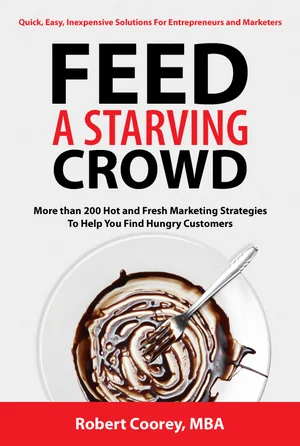
Get Feed a Starving Crowd free
Robert's first book: more than 200 low-cost marketing strategies to find hungry customers. Free PDF and ePub.
Download it freeFrequently asked questions
Can copywriting be learned?
Yes. Most great copywriters learned by copying. Many wrote out classic sales letters by hand to absorb the rhythm, studied what worked, and tested relentlessly. Start by collecting ads and pages that made you buy, then write one sales page a week for practice. The skill that takes longest to learn isn't writing. It's understanding a market deeply enough to know what to say.
How long should sales copy be?
As long as it needs to be to answer every question a buyer has, and not a word longer. A free trial or cheap product for a warm audience may need a page or two. A $1,000 program for a cold audience may need thousands of words or a long video. If your buyer still has unanswered objections when they reach the button, the copy is too short.
What is the AIDA formula?
AIDA stands for Attention, Interest, Desire and Action. It's the classic structure for short copy: grab attention with the headline, build interest with a story or problem, create desire with benefits and proof, then ask for the action. It works well for short pages and emails. Longer, higher-priced offers usually need more proof, an offer section and objection handling.
Should I write in first person or third person?
For most small businesses, first person. People buy from people. "I started this clinic after..." is warmer and more believable than "The clinic was founded to...". Use "you" far more than "we". If you're a larger brand, "we" is fine, but keep the focus on the reader's problem, not your company history.
How many headlines should I write?
Far more than feels sensible. Upworthy, which became one of the fastest-growing sites of the early 2010s, reportedly had its curators write at least 25 headlines for every article. With AI, generating 25 variants takes seconds, so the real work is choosing. Shortlist the three most specific and surprising, then let a small test decide.

Get both books free
The Subscription Playbook (ebook + audiobook) and Feed a Starving Crowd, instantly. In Australia? Claim the free hardcover.

Robert Coorey, MBA
Robert is the author of The Subscription Playbook and Feed a Starving Crowd and a Director at BPAG Accountants in Sydney. More about Robert.
Sources
- Robert Coorey, Feed a Starving Crowd, Chapter 4 (2013/14)
- Google Search Central, Google Search's guidance about AI-generated content (Feb 2023)
Facts and prices checked 27 October 2026. Spotted something out of date? Tell us.