The best marketing strategies for a small business with no budget are the ones that use assets you already have: your existing customers, contacts and partners. Ask for referrals, email past customers, partner with businesses that serve the same people, claim your free Google Business Profile, answer real questions in search, AI assistants and communities, run free live sessions, and fix your conversion rate before buying traffic.
Key takeaways
- Start with what you already own: past customers, contacts, partners and your own website.
- Fix conversion before buying traffic. A better follow-up or checkout is the cheapest growth there is.
- In 2026, being the useful answer in search, AI assistants and communities is the new free advertising.
- Free marketing still costs time. Do fewer ideas properly rather than all 101 badly.
- Pick five ideas this week, measure them, and keep the ones that ring the bell.
My very first marketing campaign was a single ad for my DJ business. It cost me about $1,000, which felt like a fortune at the time.
The phone rang. People I'd never met booked me for their parties because of one ad.
That was the moment I realized marketing was a skill you could learn. And over the next twenty-odd years, the biggest lesson was this: the best marketing often costs nothing at all. It just takes thinking, and the willingness to try lots of things.
So, how do you get customers when you don't have a budget?
Here are 101 ideas. Some are straight from Feed a Starving Crowd. Many are 2026 updates of tactics that have stopped working. (RIP StumbleUpon.) None of them needs more than a small amount of money.
Don't try all 101. Read the list, tick ten that fit your business, then do five properly.
What are the best marketing strategies for a small business with no budget?
If I could only pick five from this list, they'd be:
- Email your past customers with a genuine reason to come back.
- Ask your happiest customers for one introduction each.
- Partner with businesses that serve the same customers and refer to each other.
- Answer your customers' real questions wherever they ask them: Google, AI assistants, communities.
- Fix your follow-up and checkout so you stop losing people who already wanted to buy.
Notice that none of those involves finding strangers. Strangers are expensive. People who already know you, or know someone who knows you, are cheap.
Ideas 1 to 10: Start with the people you already know
"I don't have a list" is the most common excuse I hear. You do. You have lots of them.
- Export your LinkedIn connections and pick out everyone who could buy or refer.
- Go through your phone contacts. Message the twenty most relevant people personally.
- Dig out the business cards in your drawer and send a short note to each.
- Email past customers with something useful, not just a sale.
- Revive a cold list with the "first name" email. Subject line: their first name. Body: "Hey [name], are you still interested in [what you sell]?" I learned it from Jon Benson, who learned it from Dean Jackson. For one real estate client, it got more than 300 webinar registrations from a list of 5,000 people who hadn't engaged in months.
- Tell your personal network once what you're doing. Once. More than that gets annoying.
- Call your five best customers and ask what they'd want from you next.
- Ask for one introduction at the end of every successful job.
- Reconnect with old colleagues. Many now work somewhere that could buy from you.
- Get your team involved. At E-Web, forty staff posting about an event at the same time helped fill a seminar.
Ideas 11 to 20: Free search and AI visibility
The search box has split in two. People still Google, and they also ask AI assistants. OpenAI said ChatGPT had 800 million weekly users in October 2025. Be the useful answer in both.
- Claim and complete your free Google Business Profile. Photos, hours, services, posts.
- Ask every happy customer for a Google review, with a direct link.
- Reply to every review, good and bad. Future customers read the replies.
- List twenty questions customers ask you and answer each on your website.
- Write one genuinely helpful guide for your most important search phrase, like I did for my dad's excess stock business.
- Ask the main AI assistants the questions your customers ask. Note who gets recommended and what's missing.
- Publish your prices (or a "from" price). Pages with real numbers tend to get quoted, linked and trusted.
- Get listed in the directories your industry actually uses, such as associations and marketplaces.
- Add a clear FAQ section to every service page, written in your customers' words.
- Run a free website audit with the Website Subscription Audit and fix the three biggest issues.
Ideas 21 to 30: Content people actually engage with
- The top 100 posts method. List the 100 most-shared articles in your industry, sort by engagement, and write your own take on the top topics. For one client, six posts on a brand-new blog produced 386 seminar registrations in a month.
- The three-star review method. Read three-star reviews of the top books or products in your niche and write the content they're missing. More in how to find a niche market.
- Write 25 headlines for every important piece, then pick the best.
- Turn customer questions into short posts. One question, one answer.
- Share a customer story every month, with permission and real details.
- Show your working. A teardown, a before-and-after, a behind-the-scenes look.
- Publish a simple calculator or checklist your customers can use. Tools get shared.
- Repurpose one idea five ways: a post, a short video, an email, a carousel, a talk.
- Point paid or social traffic to a great article with a call to action at the end, not just to a sales page. For one event client, after weeks of testing, blog posts converted better than sending ads straight to the landing page.
- Write a book or a short guide. It's the best business card there is. (I'm biased.)
Ideas 31 to 42: Short video and social
In the book I wrote about StumbleUpon, SlideShare and early Pinterest tricks. Most of those are gone or changed. The principles survive: go where your crowd is, be useful, be human. My social media guide has the detail.
- Post short vertical videos answering one customer question each, on TikTok, Reels or YouTube Shorts.
- Film the founder. Raw and real usually beats polished and corporate for small businesses.
- Post on LinkedIn as a person, not just as a company page.
- Comment generously on posts by people your customers follow.
- Be genuinely helpful in Reddit threads and Facebook groups before you ever mention your business.
- Share other people's useful content too. Buyers trust a source that helps them, whoever wrote it.
- Cut one live session into ten clips.
- Run a simple competition where entries are shared publicly.
- Create a branded challenge (a 30-day challenge, a hall of fame). A bar in Texas gives a T-shirt and a hall-of-fame spot to anyone who drinks all fifty of its beers. Copy the idea, not the beers.
- Invite customers to tag you and reshare the best posts.
- Partner with one micro-creator in your niche for a product swap or commission.
- Go positive and emotional. Wharton research I quoted in the book found content that's positive and emotionally charged is more likely to be shared. A post on our non-profit Punnky page got more than 100,000 likes and 22,000 shares in a few days.
Ideas 43 to 52: Email and SMS
- Send a welcome sequence to every new subscriber, not just a single email.
- Email at least monthly. A list you don't email goes cold.
- Write like a letter to one friend. Your readers are bored, and each reads alone.
- Send a "we miss you" email to customers who haven't bought in six months.
- Text reminders before appointments and events. Our 60% webinar show rate used five emails plus an SMS.
- Send a fill-in-the-blanks workbook 48 hours before a webinar. People turn up to fill it in.
- Swap newsletter mentions with a business that serves the same customers.
- Sponsor a small niche newsletter instead of buying broad ads.
- Put one clear call to action in every email. One.
- Ask a question in your emails and reply to every answer personally.
Ideas 53 to 64: Partnerships, referrals and joint ventures
These are my favorites, because other people do the reaching for you. More in affiliates, JVs and partners and referral programs.
- List every associated business that serves your customers. A group of dance studio owners I worked with listed swim schools, art schools, preschools and dancewear shops, then swapped referrals. It cost nothing.
- Give a reward only after the referred customer pays. Then every reward is covered.
- Offer both sides something, such as a free month for the referrer and the friend.
- Pay ongoing commissions to partners who refer often, if your margins allow.
- Co-host a webinar with a complementary business and share the list.
- Bundle with a partner. A gym and a physio, an accountant and a lawyer, a cafe and a bakery.
- Ask suppliers to feature you in their newsletters or case studies.
- Integrate with the tools your customers already use, and get listed in those tools' app directories.
- Run an affiliate leaderboard with prizes for the top partners during a launch.
- Guest on podcasts your customers listen to. Bring one great story.
- Write for another business's blog or newsletter. Give your ideas away freely. The more you give, the more you receive.
- Offer professional advisers a referral pathway. Accountants, brokers and consultants are trusted introducers.
Know what a customer is worth before you spend
Work out what you can afford to pay for a customer with the free LTV:CAC and payback calculator.
Ideas 65 to 74: Local and offline
- Give unforgettable service. Harry, my mechanic, rang around town for the cheapest radiator, drove across Sydney to collect it and worked late so I could drive to work the next day. His website was full of broken links. Nothing in my book works as well as that.
- Ask just one more time. A car wash attendant offered me a wax and I said no. If he'd asked once more, I'd have said yes.
- Branded items people want. Roses Only sold quality branded umbrellas below cost, and on a rainy Sydney day thousands of people advertised for it.
- Fix the boring thing your industry gets wrong. BP put proper cafes with barista-trained staff into service stations where everyone else served awful coffee.
- Speak at local business groups, chambers and associations.
- Run a free workshop at your premises or a partner's.
- Put a QR code on receipts, packaging and invoices that leads to a referral offer.
- Send handwritten thank-you cards to new customers.
- Join or start a local community group around your expertise.
- Get someone external to read your marketing. A trade show client had zero registrations because its first paragraph said the old venue was being demolished. We changed it to "We're delighted to announce an amazing new venue" and registrations came back.
Ideas 75 to 82: PR and getting talked about
- Pitch one journalist an exclusive, not a press release to everyone. Click Frenzy's PR launch started with one TV exclusive.
- Comment on news in your industry quickly, with a strong opinion.
- Publish original data, even a small survey of your own customers.
- Create a day or an event. We co-founded Punnky's World High-Five Day with no budget, and thousands of people across four continents took part.
- Enter awards that your customers recognize.
- Answer journalists' requests for expert sources in your field.
- Launch on Product Hunt or a niche equivalent if you sell software.
- Write an opinionated post on a topic your industry avoids.
Ideas 83 to 92: Events, webinars and community
- Run a free webinar: 55 minutes of teaching, five minutes of offer. My bare-bones launch did $7,976 this way. See launch fast and cheap.
- Offer two session times. Almost as many people choose the later one.
- Record everything and use the replays as lead magnets.
- Leave plenty of time for Q&A. It's where the real objections come out.
- Start a free community for your customers on whatever platform they already use.
- Spotlight a member each week.
- Run a monthly "ask me anything."
- Host a customer-only event and let each member bring a friend.
- Tell transformational stories, not a million tips. Give too much away and people leave overwhelmed and buy nothing. I learned this the hard way at a $47 seminar.
- Be faithful with the small. The Feed a Starving Crowd group went from zero members to ten, to a hundred, to a thousand, and on toward two thousand.
Ideas 93 to 101: Sales and conversion (free money already in your funnel)
- Measure your checkout abandonment. Most businesses don't.
- Remove form fields you don't use.
- Test one thing a month on your main page. You're always trying to beat your high score.
- Remove a step from your funnel and test it. Cutting one step once halved our cost per lead.
- Add a real reason to act now. See scarcity without being slimy.
- Follow up every enquiry within the hour.
- Raise your prices if you're always busy. It's free money.
- Turn one-off customers into subscribers. Recurring revenue makes every marketing dollar work harder. Start with the subscription model selector.
- Keep going. For one consulting client, three weeks of tests produced almost nothing. Then one more split test and fresh ad copy brought 15 qualified leads in a weekend. You're only ever one more test away.
When does free marketing cost too much?
When I started my first business, I did everything myself. The website, the copy, the CRM, the accounts, the blog posts. I thought I was saving money.
I wasn't losing money. I was losing time. And the business grew painfully slowly.
Worked example: what “free” really costs (illustrative)
Say your time is worth $150 an hour in client work. You spend eight hours a week on DIY social media that brings in one new customer a month worth $1,200 in gross profit. That's about 35 hours a month, or roughly $5,200 of your time, to make $1,200. A $300 partner newsletter that brings two customers is far cheaper. Track your hours like you track your dollars.
Low-budget marketing is the right choice when you're testing, when cash is tight, or when relationships matter more than reach. It's the wrong choice when it keeps you from the work only you can do. Once a channel is working, spend money to scale it.
For a subscription business, the four techniques in The Subscription Playbook (community, webinars, referrals and integrations) are covered in depth in my guide to growing on a shoestring budget.
What to do next
- Tick ten ideas that fit your business.
- Circle five you can start this week.
- Set one number for each, such as replies, bookings or sign-ups.
- Review in thirty days. Keep the winners, drop the rest.
- Know your numbers before you spend: what a customer is worth and what you can afford to pay for one.
The rest of the Feed a Starving Crowd marketing hub goes deeper on every one of these ideas.
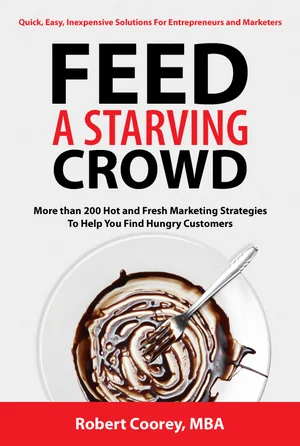
Get Feed a Starving Crowd free
Robert's first book: more than 200 low-cost marketing strategies to find hungry customers. Free PDF and ePub.
Download it freeFrequently asked questions
What is the cheapest form of marketing?
Talking to people who already know you. Emailing past customers, asking happy clients for referrals and reconnecting with your network cost nothing and convert far better than strangers. Close behind are partnerships with businesses that serve the same customers, and genuinely helpful answers in the places your customers ask questions. Paid ads are rarely the cheapest place to start.
How much should a small business spend on marketing?
There's no single right percentage. A better way is to work out what a customer is worth to you in gross profit over their lifetime, then decide how much of that you're willing to spend to win one. If a customer brings $2,000 of profit, spending $200 to acquire them is sensible. Start with free channels, measure what converts, then put money behind the winners.
How do I market my business with no money and no time?
Pick the two ideas with the shortest path to a sale. For most businesses that's emailing past customers with a reason to come back, and asking your five happiest customers for an introduction. Both take under an hour. Then block one hour a week for one longer-term channel, such as answering questions online or a monthly partner email. Consistency beats intensity.
Is social media marketing free?
Posting is free, but reach isn't guaranteed. Most platforms show business posts to a small share of followers unless they're genuinely engaging. Short video, personal posts from the owner and helpful answers in groups tend to travel further than polished brand posts. Treat social as a way to build relationships and an email list, not as your only channel.
Do low-budget tactics work for subscription businesses?
They work especially well, because a subscriber keeps paying after you win them. Referral programs, communities, free webinars and partner integrations all suit subscriptions. The trick is to measure what each new subscriber is worth over their lifetime, so you know which tactics are worth scaling. The Subscription Playbook's shoestring chapter covers four techniques in depth.

Get both books free
The Subscription Playbook (ebook + audiobook) and Feed a Starving Crowd, instantly. In Australia? Claim the free hardcover.

Robert Coorey, MBA
Robert is the author of The Subscription Playbook and Feed a Starving Crowd and a Director at BPAG Accountants in Sydney. More about Robert.
Sources
- Robert Coorey, Feed a Starving Crowd (2013/14) and Feed a Starving Crowd community posts
- Robert Coorey, The Subscription Playbook, Chapter 8 (2022)
- Google Business Profile
- TechCrunch, Sam Altman says ChatGPT has hit 800M weekly active users (6 Oct 2025)
Facts and prices checked 27 October 2026. Spotted something out of date? Tell us.