To find a niche market, start with a broad market you understand, then look for a group inside it with a painful, specific problem that current products handle badly. Read three-star reviews, forum and comment complaints, and search trends to confirm the demand. Score each niche on pain, spending, reach and staying power, then test it cheaply with ads or a waitlist before you build.
Key takeaways
- Follow the complaints, not just your passion. Three-star reviews are the best free market research there is.
- A good niche has a specific person, a painful problem, money already being spent, and a cheap way to reach them.
- In 2026 the complaints live in Reddit threads, video comments, app store and software reviews, and AI assistant answers.
- Test the name and the promise with a tiny ad budget or a waitlist before you build anything.
A while back I was reading up on self-publishing and came across a book by Guy Kawasaki called APE: Author, Publisher, Entrepreneur.
Before buying it, I read the reviews. (Don't we all?)
One review stood out. It was long and detailed, and it gave the book three stars. The reviewer said it didn't help unknown, first-time authors very much.
That was my "aha" moment.
Thousands of people want to write and self-publish a book. They have no marketing budget. They have plenty of time. They're not scared of menial tasks. And every one of them thinks their book is the best thing ever written. (Fair enough. It probably is.)
That's a starving crowd. And I found it in a three-star review.
How do you find a niche market?
Here's the short version of my method:
- Start with a market you understand. Your industry, your past job, your hobby, your customers.
- List the people inside it. Who exactly buys? Who struggles most? Who's ignored?
- Read their complaints. Three-star reviews, forums, comments, support tickets.
- Check the demand. Search volume, search trends, and whether money is already being spent.
- Score each niche. Pain, spending, reach and staying power.
- Test before you build. A tiny ad test, a waitlist or a pre-sale.
A niche is a starving crowd you can name. Broad markets are too expensive to reach and too crowded to stand out in. A niche gives you one person to talk to and one place to find them.
Let me walk you through each part.
Why are three-star reviews the best market research?
In my opinion, three-star reviews are the sweet spot.
Anyone who gives one star is often angry. Anyone who gives five stars is often a fan. Three-star reviewers have usually read the whole thing, enjoyed parts of it, and have clear, constructive reasons why it fell short.
Before I wrote Feed a Starving Crowd, I read the three-star reviews of the top 100 marketing books on Amazon. Here are the most common complaints I found:
- Nothing particularly new, just a revision of accepted principles
- No specific information, all general advice
- Takes forever to get to the point, too much waffle
- Outdated information, the tips don't work anymore
- Doesn't help you if you're just starting out
- No processes or steps to follow, doesn't show you the how
- Most of the information can be found online for free
I kept that list next to me the whole time I wrote the book. Every chapter, I checked it against the list.
The three-star method in 2026
Books are still a great place to look. But the same method now works on almost every review site:
| Where to look | What you're looking for | Best for |
|---|---|---|
| Amazon book reviews | What the "experts" in your field fail to teach | Information products, coaching, courses |
| App store reviews | Features people beg for, bugs that make them leave | Apps and consumer subscriptions |
| G2 and Capterra | Why businesses switch software | B2B software and services |
| Google reviews of local competitors | What frustrates customers in your suburb | Local service businesses |
| Reddit threads and video comments | Raw, unfiltered problems in people's own words | Almost everything |
| AI assistant answers | What gets recommended, and what's missing | Spotting gaps competitors haven't filled |
If you collect a big pile of complaints, paste them into the customer pain-point analyser. It groups them into themes so you can see which pain comes up most.
How did Eben Pagan find a $100 million gap?
When online marketer Eben Pagan was single and looking for tips on meeting "Miss Right," he noticed something. Every book on the shelf taught you how to improve a relationship you already had.
His problem was that he couldn't get the relationship started in the first place.
Nobody was teaching that. So he wrote Double Your Dating, which became the start of an information marketing business that generated more than $100 million.
Dr Libby Weaver did the same thing with cookbooks. She looked at the shelves and saw a gap for healthy recipes that were easy to make and actually tasted great. Her book Real Food Chef was a #1 bestseller for more than twelve months straight.
Neither of them invented a new market. They found a hungry group inside an existing one that nobody was feeding properly.
How do you research a niche market in depth?
Once you have a promising niche, get to know the people in it better than your competitors do.
Ewa Wysocka from Mindvalley had a great method. She'd go into relevant Facebook groups, read the comments, then look at the profiles of the people commenting. How old were they? Did they have kids? What were their hobbies? She'd look for what they had in common and turn it into a customer avatar.
For one of Mindvalley's million-dollar launches, the avatar included people who were:
- 35 or older, men and women
- mostly professionals with small private practices or small business owners
- following blogs and newsletters on meditation and personal growth
- successful in their careers but unhappy with their current income
- looking for a change at the start of the year
That last point is gold. It told Mindvalley when to launch, not just who to target.
In 2026 you can do the same with LinkedIn profiles, community member lists, podcast reviews and the people who comment on creators in your niche. AI tools can help summarize what you find. Just don't let them make up the avatar for you. Use real people.
Where do you find a niche with high demand and low competition?
Honestly? "High demand, low competition" is rare, and when you find it, it doesn't last long. What you're usually looking for is high demand and poor competition: plenty of competitors, but none of them doing a great job for one particular group.
Signs you've found one:
- People complain about the same thing across several competitors
- The top results in search, or the top answers from AI assistants, are generic and not written for this group
- Customers have built their own workarounds (spreadsheets, Facebook groups, DIY hacks)
- Competitors serve this group as an afterthought ("we also work with...")
In the original book I recommended checking ClickBank's "gravity" score to see which information products affiliates were actively promoting. That still tells you something about digital products. But for most businesses today, I'd look at what's selling in your category on marketplaces, which paid communities and newsletters are growing, and which local competitors have waiting lists.
Niche examples for subscription businesses (illustrative)
| Broad market | Niche | Why the hunger repeats |
|---|---|---|
| Fitness | Pilates for new mums returning to exercise | Weekly classes, a clear 6 to 12 month journey |
| Accounting | Bookkeeping for short-stay property hosts | Monthly transactions, quarterly GST, annual tax |
| Coffee | Office coffee for workplaces of 10 to 50 people | Beans run out every week |
| Pet care | Mobile grooming for double-coated breeds | Coats need regular care, owners hate the mess |
| Trades | Maintenance plans for strata buildings | Compliance checks recur every year |
| Software | Rostering for independent pharmacies | Shifts change every week |
For more starting points, see my list of 101 subscription business ideas and the guides to subscriptions by industry.
Starving Crowd Niche FinderScore niche ideas the Feed a Starving Crowd way.Open the free tool →How do you test a niche before you build anything?
Before publishing Feed a Starving Crowd, I spent about six months on the title. I got it down to three:
- Feed a Starving Crowd
- Instant Marketing Genius
- Double Your Business Without Advertising
Then I stopped guessing. I ran a Facebook ads campaign for 48 hours and spent $20 on each title.
Feed a Starving Crowd had the highest click-through rate by a clear margin. That's how the book got its name. Then I ran the same test for the subtitle.
Sixty dollars to settle a six-month debate. Not bad.
Tim Ferriss tested his book titles with Google ads in the same way. And Eben Pagan names products after the ultimate benefit the buyer wants, often with alliteration or rhyme so they stick.
How I'd test a niche in 2026:
- A tiny ad test. Put the same small budget behind two or three one-line promises, each aimed at a different niche. Compare clicks and sign-ups. My guide to Meta ads on a small budget covers the mechanics.
- A waitlist page. One headline, one promise, one email box. See who signs up. (More on this in landing pages that convert.)
- Twenty conversations. Message twenty people in the niche and ask about the problem, not your product. If they lean in and ask "where can I get this?", you're onto something.
- A synthetic sanity check. The synthetic customer panel lets you try a promise on simulated personas before you spend anything. Treat it as a rehearsal, not proof. Real money from real people is the only proof.
Score your niche ideas in five minutes
Put each niche through the Starving Crowd Niche Finder and see which one is genuinely hungry.
How can a niche market position be advantageous?
A tight niche gives you advantages a generalist can't buy:
- Cheaper marketing. You know exactly where your people gather, so you waste less on ads.
- Better word of mouth. People in a niche talk to each other. One happy customer at an industry event can bring you five more.
- Pricing power. A specialist can charge more than a generalist. Nobody wants a "general" surgeon for heart surgery.
- Copy that writes itself. When you know one group deeply, your copywriting speaks their language.
- A moat. Deep knowledge of one niche, plus a reputation in it, is hard to copy. In The Subscription Playbook I call this building your moat.
When is a niche too small?
Be honest with yourself here.
A niche is too small if you can't reach enough paying customers to cover your costs and pay yourself, even with a strong share of the market. It's also too narrow if the people in it don't see themselves as a group. "Left-handed dentists who surf" is specific, but there's nowhere to find them and nothing they share as buyers.
The fix is usually to widen one dimension, not all of them. Keep the problem specific and widen the location. Or keep the person specific and widen the problem.
What to do next
- Pick one broad market you understand.
- List five niches inside it, each with a specific person and a specific problem.
- Read thirty three-star reviews or complaints for each. Write down the exact words people use.
- Score each niche with the Starving Crowd Niche Finder.
- Test your top two with a small ad test, a waitlist or twenty conversations.
Then move on to launching fast and cheap, so the crowd you've found can actually start paying you.
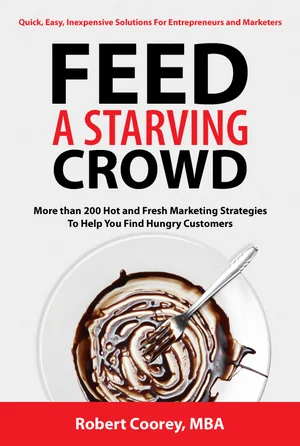
Get Feed a Starving Crowd free
Robert's first book: more than 200 low-cost marketing strategies to find hungry customers. Free PDF and ePub.
Download it freeFrequently asked questions
How do I know if a niche is profitable?
Look for proof that money is already changing hands. Are there competitors charging real prices? Are people paying for courses, consultants, apps or workarounds? Then do the math: estimate how many customers you could reach, at what price, and what it costs to serve them. If a small share of the niche covers your costs and pays you well, it's worth testing.
What is an example of a niche market?
Fitness is a market. Pilates for new mums returning to exercise is a niche. Accounting is a market. Bookkeeping for short-stay property hosts is a niche. Coffee is a market. Office coffee for workplaces of ten to fifty people is a niche. Each niche has a specific person, a specific problem and a specific place you can find them.
Can AI tools find a niche for me?
They can speed up the research, but they can't replace it. AI assistants are great for brainstorming sub-niches, summarizing hundreds of reviews and suggesting search phrases. But they can also invent trends that don't exist. Always confirm demand with real evidence: search data, real complaints, competitor pricing and, best of all, people who pay you.
Should I pick a niche I'm passionate about?
Passion helps you keep going, and knowing a market from the inside makes your marketing far better. But passion without hunger is a hobby. The sweet spot is a market you understand or care about where people are already complaining loudly and spending money. If you love something nobody needs, keep it as a hobby.
How many niches should I test at once?
Three to five is plenty. Write a one-line promise for each, run a small, equal test for each one (the same ad budget, the same audience size, or the same number of personal messages), and compare the response. Pick the winner and go deep. Testing ten at once spreads your budget too thin to learn anything.

Get both books free
The Subscription Playbook (ebook + audiobook) and Feed a Starving Crowd, instantly. In Australia? Claim the free hardcover.

Robert Coorey, MBA
Robert is the author of The Subscription Playbook and Feed a Starving Crowd and a Director at BPAG Accountants in Sydney. More about Robert.
Sources
Facts and prices checked 27 October 2026. Spotted something out of date? Tell us.