A starving crowd is a group of people who already want what you sell, badly, and are actively looking for it. The idea comes from copywriter Gary Halbert, who said he'd beat any hamburger stand if he had just one advantage: a starving crowd. Find the hunger first, then build the product and marketing to feed it.
Key takeaways
- A starving crowd beats better products, better locations and lower prices. Find the hunger before you build anything.
- Look for pain people can name, money they already spend, a cheap way to reach them, and demand that is steady or growing.
- People buy for reasons they will tell you, reasons they won't tell you, and reasons they can't tell you. Your marketing has to speak to all three.
- For a subscription, the hunger has to come back every month. One-off hunger makes one-off sales.
Here's a story from my mentor Gary Halbert that I've never forgotten.
Halbert was running a direct marketing course. He asked his students a question:
"If you and I both owned a hamburger stand and we were in a contest to see who could sell the most hamburgers, what advantages would you most like to have on your side to help you win?"
The answers came thick and fast. Better quality meat. Sesame seed buns. The best location. The lowest prices.
Halbert listened. Then he said he'd happily give them every one of those advantages if he could have just one. With that one advantage, he'd wipe the floor with them.
What was it?
A starving crowd.
That story gave my first book its name. And more than a decade later, it's still the first thing I check before I spend a dollar on marketing. There's no point making dinner if nobody's hungry.
What is a starving crowd?
A starving crowd is a group of people who already want what you sell, want it badly, and are actively looking for a solution.
You don't have to convince them they have a problem. They know. They're searching for answers, asking friends, reading reviews and complaining in forums. Many of them are already spending money on something that doesn't quite work.
Compare that with a "cold" market, where you first have to persuade people they have a problem, then persuade them your solution is the answer, then persuade them to buy now. That's three sales instead of one. It's possible. Big brands do it. But it's slow and expensive, and on a small budget it usually fails.
So the rule is simple: find the hunger first, then build the product and the marketing to feed it.
How did I find a starving crowd for my dad's business without spending a cent on ads?
When I first started learning this stuff, I needed a guinea pig. One phone call to my father later, I had one. (At worst, I figured I'd drop off his Christmas card list.)
Dad's business buys and sells excess stock. Think about who needs that: a business owner with a warehouse full of products they can't shift. That's a hungry person.
So I put myself in their shoes and wrote down every question they'd have:
- How low do I need to go on price? (Really meaning: I'm afraid of losing too much money.)
- How quickly will the stock sell? (Really meaning: I'm sick of seeing my warehouse full of old stock.)
- How discreet will the process be? (Really meaning: this is a bit embarrassing and I don't want anyone to know.)
Next, I listed every phrase someone might type into a search engine if they wanted to sell excess stock. I came up with 127. I ran them through Google's keyword tool and picked the twenty with the highest volume and lowest competition. Then I checked Google Trends to make sure the demand was steady over time, not a one-off spike.
With those twenty keywords, we did some basic search engine optimization, refreshed the homepage (my brother built it for free, which is the great thing about having a web developer in the family) and added a two-minute animated video that cost a few hundred dollars.
That process generated more than 1,000 solid leads. At one stage Dad was starting early and finishing late just to keep up.
We didn't spend a cent on advertising.
The crowd was already there. We just sent out the invitations.
How I'd do the same research in 2026
The principle hasn't changed. The places people reveal their hunger have multiplied.
- Search still matters. Google's keyword tools and Google Trends still tell you whether people are actively looking and whether demand is steady, seasonal or fading.
- AI assistants are the new search box. OpenAI said in October 2025 that ChatGPT had 800 million weekly users. Ask the main assistants the questions your customers would ask. Who gets recommended? What problems come up? What's missing from the answers?
- Comments are the new forums. The richest complaints now sit under TikTok and YouTube videos, in Reddit threads and in Facebook and LinkedIn groups. Read the comments, not just the posts.
- Reviews are still gold. Amazon book reviews, app store reviews, Google reviews of local competitors and G2 or Capterra reviews of software. I'll show you my three-star method in the guide to how to find a niche market.
If you have a pile of reviews, emails or support tickets, paste them into the customer pain-point analyser and it will group the complaints for you.
Why do people buy? The three layers of hunger
Here's the tricky part. People rarely tell you the real reason they buy.
My friend Alexi Neocleous, one of Australia's top copywriters, taught me to think of every market as having layers.
- "Will tell" reasons. What people say to strangers. A fifty-year-old man buys a sports car and says, "I love the acceleration," or "I got a great deal."
- "Won't tell" reasons. What people think but keep to themselves. He wants to impress his friends. The car says "I've made it."
- "Can't tell" reasons. Deep motivations people may not even admit to themselves. Status, attractiveness, not wanting to grow old alone.
You can't write "this car will make you feel young and desirable" in an ad. But you can show it. That's why so much great advertising sells an image or a story rather than a spec sheet.
Surveys only capture the first layer. To get to the second and third, you have to listen to people in their own words, in places where they're talking to each other rather than to you.
“That's me!” How Dr Libby knew her crowd better than they knew themselves
Dr Libby Weaver, the nutritional biochemist, worked with my team on her online marketing. Out of everyone I've worked with, she knew her customers best by far, after years of private consultations where women shared their deepest worries with her. At a list-building seminar in our office, someone mentioned her book Rushing Woman's Syndrome. Out of the blue, a woman in the audience said, "That's me!" She was sold on the title alone. Dr Libby also asked her fans what they wanted in her next book. The most requested topic was how to get rid of dark circles under the eyes, so we built much of the campaign around that one message.
The four signs your crowd is starving
Over the years I've boiled it down to four questions. If a market scores well on all four, I get excited. If it fails one badly, I keep looking.
| Sign | The question to ask | Good sign | Warning sign |
|---|---|---|---|
| 1. Pain you can hear | Do people describe this problem in their own words, unprompted? | Complaints in reviews, comments and forums | You have to explain the problem to them |
| 2. Money already moving | Are they already spending on a fix, even a bad one? | Competitors, workarounds, paid courses, agencies | "Great idea" but nobody has paid for anything |
| 3. Cheap to reach | Can you find them in one place for little money? | Groups, associations, hashtags, newsletters, trade shows | Scattered, with no shared place or label |
| 4. Steady or growing demand | Is the hunger lasting, not a fad? | Flat or rising search trends over several years | One spike, then a slide |
For a subscription business I add a fifth.
5. Does the hunger come back? One-off hunger makes one-off sales. If the problem returns every week or month (dirty cars, tax deadlines, a pet that needs grooming, software that needs updating), you can build recurring revenue around it.
Worked example: scoring two crowds for a physio clinic (illustrative)
A physio wants to launch a monthly membership. Crowd A is "people with sore backs." Crowd B is "office workers in the CBD who sit at a desk all day and have recurring neck and back pain." Score each sign from 1 to 5. Crowd A: pain 4, money 3, reach 1 (they're everywhere and nowhere), demand 4, recurring 3, total 15 out of 25. Crowd B: pain 5, money 4 (many already pay for massages and standing desks), reach 4 (office towers, LinkedIn, employer wellness programs), demand 4, recurring 5, total 22 out of 25. Same clinic, same skills. Crowd B is the starving one.
Why the starving crowd matters even more for subscriptions
When you sell something once, you only need the crowd to be hungry once.
A subscription is different. You need them to stay hungry, month after month. If the hunger fades, they cancel. That's what churn really is: a crowd that's been fed and no longer feels hungry.
That's why the businesses that win with subscriptions pick problems that keep coming back. It's also why I spend so much time in The Subscription Playbook on choosing the right subscription model for the kind of hunger you're feeding, and on keeping customers from churning.
A starving crowd also makes everything else cheaper. Your ads convert better. Your copy doesn't need to work as hard. People refer friends because they know others with the same problem. And when you eventually test for product/market fit, you're far more likely to pass.
Is your crowd actually starving?
Score your market on pain, spending, reach and demand with the free Starving Crowd Niche Finder.
When does the starving crowd idea lead you astray?
I'd be doing you a disservice if I said hunger is all you need. Here's where I've seen it go wrong.
- Hungry but broke. Some crowds are desperate but can't pay. Students, early-stage founders and people in financial stress all fall into this. Check sign two carefully.
- Hungry for free. Some crowds want the answer, not a product. If a good AI assistant or a free YouTube video already solves the problem well enough, your paid version needs to be dramatically better.
- Hungry for a moment. Fads look like starving crowds for a few months. That's why I check Google Trends over five years, not five weeks.
- Hungry and protected. Health, finance and legal problems are often the hungriest of all, but the rules about what you can claim are strict. Feed these crowds carefully and honestly.
- Hungry, but already well fed. If ten big competitors are all doing a great job, the crowd isn't starving. It's full. Look for the part of the market they're ignoring.
What to do next
Don't just read this. Do it. Gary Halbert once made marketer Joe Polish withdraw $21,000 in cash, then threw it around the office, shouting that every day Joe didn't make the follow-up calls Gary had recommended was another $1,000 thrown away. I'd rather you didn't need that kind of lesson.
Here's your action exercise:
- Write down twenty phrases people might type into Google, or ask ChatGPT, if they needed your product.
- Check the volume and the trend for each. Keep the ten with the strongest, steadiest demand.
- Read fifty complaints about competitors or about the problem itself. Write down the words people use.
- Ask five existing customers what they'd want from you next, and what nearly stopped them buying.
- Score your crowd on the five signs above.
Then read the companion guides: how to find a niche market goes deeper on research methods, and launch fast and cheap shows you how to test whether the crowd will actually pay.
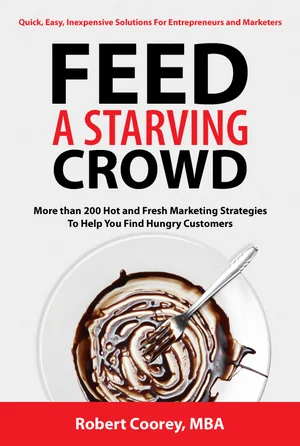
Get Feed a Starving Crowd free
Robert's first book: more than 200 low-cost marketing strategies to find hungry customers. Free PDF and ePub.
Download it freeFrequently asked questions
Did Gary Halbert or Alex Hormozi come up with the starving crowd?
Gary Halbert, the direct-mail copywriter, made the idea famous with the hamburger stand question he asked students in his direct marketing course. I learned it from Halbert's material and built my first book, Feed a Starving Crowd, around it. Alex Hormozi brought the phrase to a new generation in his 2021 book $100M Offers. The core lesson is the same in every version: the market matters more than the product or the pitch.
How big does a starving crowd need to be?
Smaller than most people think. A local physio clinic might only need a few hundred members to be very profitable, while a software company may need thousands. Work backwards from your numbers: how many customers at what price cover your costs and pay you properly? If the crowd is big enough to supply that many customers several times over, and you can reach them cheaply, it's big enough.
Can a B2B business have a starving crowd?
Absolutely. Business buyers are often the hungriest crowds of all because their pain costs them money every week. Think of accounting firms drowning in compliance work, restaurants paying heavy delivery-app commissions, or builders waiting months for approvals. Look for problems that show up in a budget line, a missed deadline or a regulator's letter. Those crowds search actively, compare options and pay for solutions.
Is a starving crowd the same as product/market fit?
No, but they're related. A starving crowd is the market before you arrive: people with an urgent, unmet need. Product/market fit is what happens when your product satisfies that need so well that customers would be very disappointed to lose it. You find the crowd first, then you earn fit by feeding it better than anyone else.
What if my market isn't hungry yet?
Then you have an education job, and education is expensive. Some great businesses created demand from scratch, but they usually had large budgets and plenty of time. On a small budget, it's far easier to move toward an existing hunger. Look for the nearest problem your customers already complain about and lead with that, even if your product does much more.

Get both books free
The Subscription Playbook (ebook + audiobook) and Feed a Starving Crowd, instantly. In Australia? Claim the free hardcover.

Robert Coorey, MBA
Robert is the author of The Subscription Playbook and Feed a Starving Crowd and a Director at BPAG Accountants in Sydney. More about Robert.
Sources
- Robert Coorey, Feed a Starving Crowd, Chapter 1 (2013/14)
- TechCrunch, Sam Altman says ChatGPT has hit 800M weekly active users (6 Oct 2025)
- Google Trends
Facts and prices checked 27 October 2026. Spotted something out of date? Tell us.